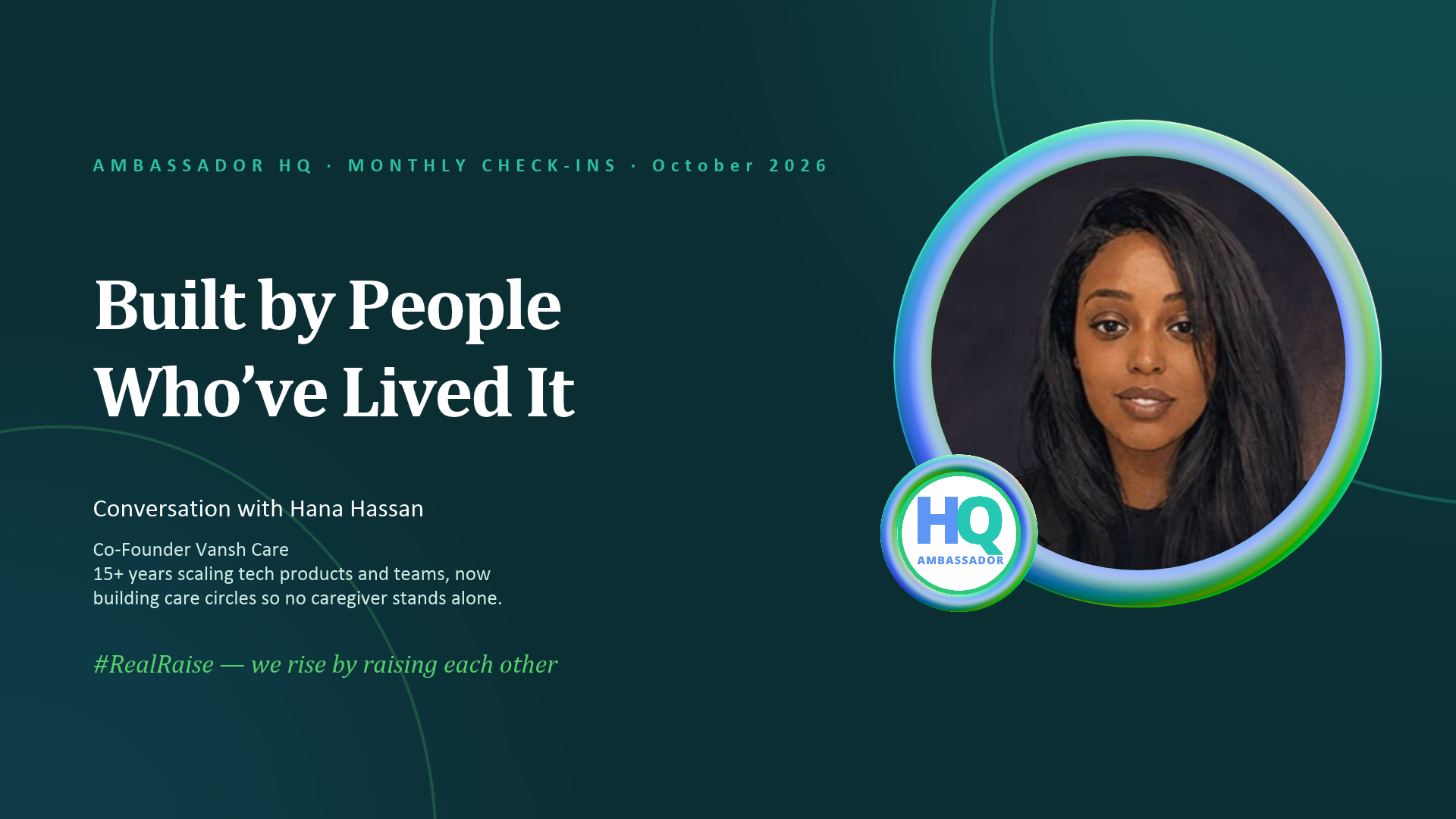
A bootstrapped team spent two years putting safety, restraint, and the caregiver experience ahead of rapid scaling to build an AI companion for dementia caregivers.
The Unseen Reality: The Second Shift
In health technology, the stakes of a design decision are higher than in most software. While breaking a feature in a photo-sharing application causes minor annoyance, breaking trust or generating inaccurate advice in a living room during a medical crisis can endanger human lives.
Enter Vansh Care, a bootstrapped platform built specifically for family caregivers of individuals living with dementia.
Co-founded by Hana Hassan and health tech executive Sarah Bettencourt, with Dr. Saad Shakeel as Chief Medical Officer, Vansh builds an AI care companion centered on safety and human dignity.
The platform takes its name from a Sanskrit word meaning family lineage and bamboo, symbolizing deep roots and interconnectedness.
To understand why Vansh exists, consider "Carol," a composite persona representing millions of dementia caregivers. At 5:00 PM, Carol finishes her daily job and returns home, where her invisible "second shift" begins: caring for her mother, who has progressive dementia. Carol manages exhausting, granular realities, including sudden mood shifts, late-night agitation, and safety scares.
Yet when Carol accompanies her mother to a 15-minute appointment with the treating physician, summarizing six months of complex behavioral observations is nearly impossible. Vital details get lost in translation, depriving clinicians of the longitudinal data needed to adjust care plans effectively.
6 Core Decisions for Building Responsible AI
During an AmbassadorHQ Peer-to-Peer Support Session, Hana Hassan outlined the six fundamental design decisions that guided Vansh from two years of quiet development to its public release.
1. Build Where the User Already Is
Caregivers managing high-stress situations do not have the time or cognitive bandwidth to download new applications, create accounts, or learn complex interfaces. Vansh operates natively within WhatsApp, meeting caregivers in an application they already open every day. Caregivers can type or send voice notes at 2:00 AM in English, French, or Spanish.
2. Limit What the AI Can Say
Unrestricted general language models are designed to generate answers even when uncertain, introducing significant risks of hallucination. Vansh strictly limits its conversational responses to a closed, stage-by-stage knowledge hub written specifically for dementia care. When Vansh does not have a verified answer, it says so and directs the caregiver to their care team.
3. Document Explicit Rules on What the AI Must Never Do
Before launch, the company set clear limits on what Vansh can and cannot do and tested it alongside physicians and caregivers. Vansh does not diagnose a condition, and it does not recommend a treatment. Its role is to share verified guidance, remember what a caregiver tells it, and help them put it into a Care Brief that they choose to share. That defined scope also keeps Vansh outside the regulatory category of Software as a Medical Device (SaMD).
4. Plan Seamless Handoffs to Humans
When critical medical events occur, AI must recognize its limits. A general chatbot may keep the conversation going and offer reassurance that sounds confident. Vansh enforces hard guardrails: it immediately stops conversational interaction and instructs the user to call 911.
5. Test with Physicians and Caregivers
Vansh spent two years in development and was tested with physicians and family caregivers before launch. That testing continues today.
6. Maintain Continuous Post-Launch Stewardship
Launch was the beginning of the work, not the end. The team keeps the knowledge hub up to date as new research emerges. Caregivers' information is de-identified and stored securely, and anyone can ask to have it deleted at any time.
Core Decision
Strategic Implementation
1. Accessibility
Works inside WhatsApp, so there is nothing new to download.
2. Restraint
Shares guidance only from a closed, stage-specific knowledge hub.
3. Hard Boundaries
Does not diagnose conditions or recommend treatments.
4. Human Handoff
Directs emergencies to 911 and refers other questions to the care team.
5. Expert Testing
Developed and continuously tested with physicians and family caregivers.
6. Continuous Responsibility
Keeps the knowledge hub current as new research emerges. De-identifies user information and deletes it on request.
Bridging the Living Room to the Clinic
Vansh takes the messages a caregiver sends day to day and organizes them into a record they can share with their care team. When Carol texts Vansh about late-afternoon agitation, the platform suggests non-pharmacological interventions, such as folding towels together to redirect focus. The next morning, Vansh checks in with Carol, not only to hear how the suggestion worked, but to ask how she is holding up.
Before an appointment or a check-in, Carol can have Vansh pull these daily notes together into a 30-second Care Brief. Whether Carol is meeting with her mother's physician, a social worker, a personal support worker, or a care navigator, each of them can see days, weeks or six months of patterns at a glance, without Carol having to retell the story every time.
That eases the load on the care team and leaves more of every conversation for planning the next steps.
Building a "Forever Home" in Health Tech
Rather than narrowing their vision, the team behind Vansh Care recognized that dementia care is an ecosystem-wide challenge. By building a bootstrapped, network-driven product, offered free to primary caregivers and sustained by institutional payers such as employers and clinics, Vansh Care establishes a stable foundation.
As community members highlighted during the support session, Vansh is not throwing up temporary digital walls; it is carefully building a "forever home" designed to support caregivers and safeguard families for years to come.